When taking Painting with light landscape shots it is best to think like an artist (perhaps a painter), who first sets up a canvas on an easel before even starting to put paint onto the palette. Similarly, a landscape Painting with light often needs to have a background shot for the resulting composite on which all of the other shots will sit (you can think of this as the canvas on which you are going to work).
This initial (background) image is unlikely to be completely black – you may want the sky to be lighter to show the silhouette of trees, or to see the moonlight, or the stars. The rest of the images you take will be completely black, all apart from the elements intentionally lit up by your torch.

So, how do we decide on what exposure settings to use to have a very dark background image, but not completely black? It is going to be largely by trial-and-error, because no two scenes are going to be the same. But with a low ISO (to minimise noise) the resultant shutter speed is going to be at least 30 seconds, maybe several minutes. Taking multiple shots at these shutter speeds to find the right one could take a long time.
The answer is to remember the six-stop rule. This simply states that:
1 second at ISO 6400 = 1 minute at ISO 100
Why is this important? Well, if you set your ISO to 6400 you can take some test shots quite quickly in order to find the optimum shutter speed (which will be seconds rather than minutes). You can then reset your camera to ISO 100 and use the same number, but this time as minutes – and you will get the same overall exposure.
For example; if you have your camera set to ISO 6400 and, after a few shots, determine that the best exposure time is 2 seconds, when you reset your camera to ISO 100 you will need an exposure time of 2 minutes to achieve the same image.
I’m sure that there are many who will now be saying to themselves “Hold on, if I can get the same image in 2 seconds as I can in 2 minutes why would I bother?”. The answer is ‘Reduced noise‘. Remember, the background image isn’t going to be completely black, there should be elements of detail (clouds, tree silhouettes, etc.) that need to be as crisp and sharp as possible. This will be possible at ISO 100 but not so much at ISO 6400.
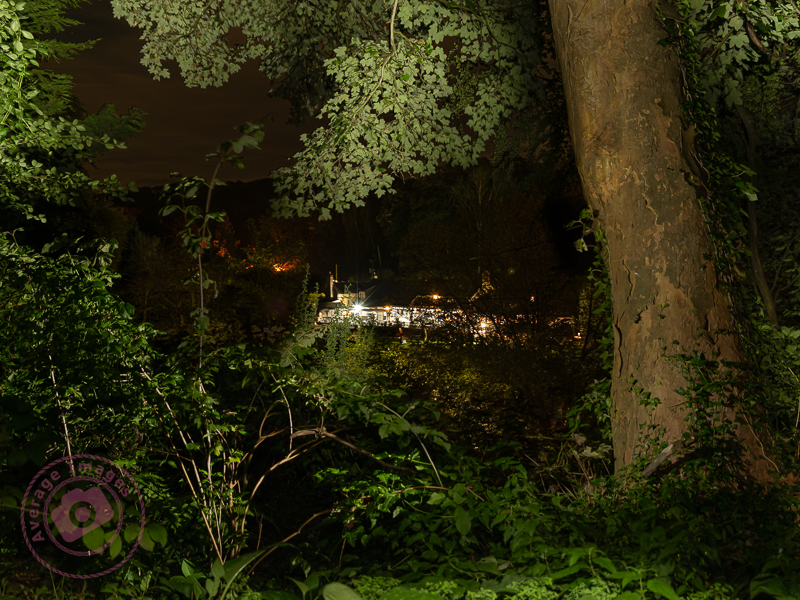
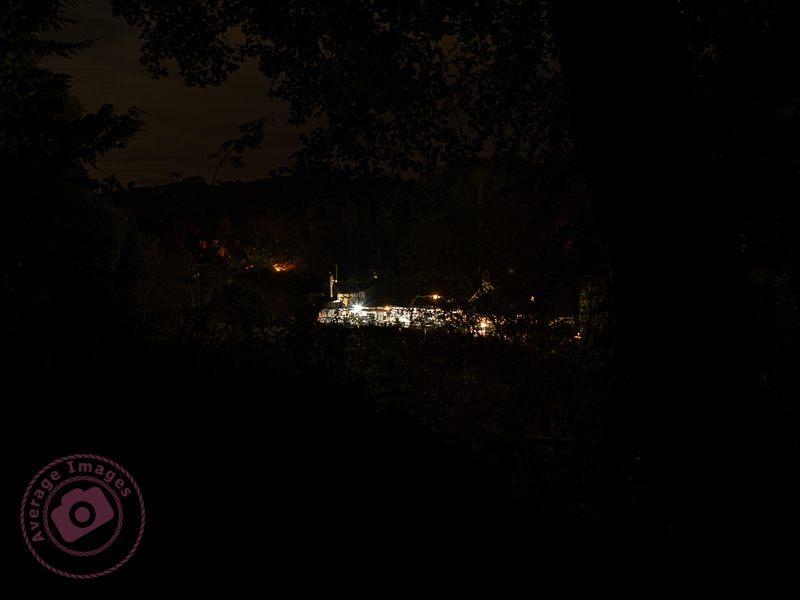
For the feature shot above, I wanted the sky to be visible above the horizon and so took that shot first. Fortunately it wasn’t too dark and so the test shot at ISO 6400 took half-a-second. I then re-set the ISO to 100 and took the another shot for half-a-minute. This created just enough light in the sky to act as my background shot.
Of course, once you have your background shot ‘in the bag’, you now have to concentrate on your ‘hero’ and ‘supporting cast’.
The feature shot above isn’t a painting with light in the true sense, because the hero (the public house) is already lit up with its own lights. To be honest, it really doesn’t work for me, but it helped illustrate the six-stop rule, which is why I used it.
Discover more from Ironbridge Images
Subscribe to get the latest posts sent to your email.

 Ironbridge Images