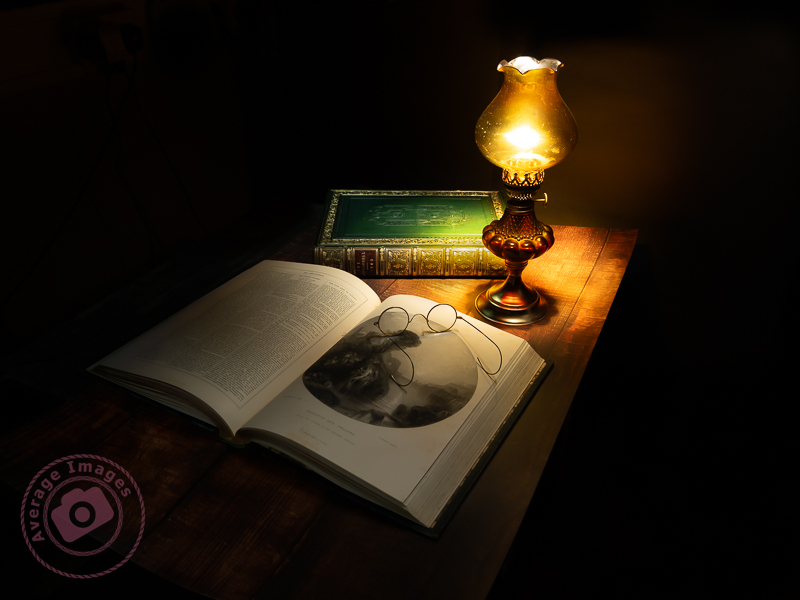
Painting with light doesn’t always have to be done outside – you can also create some very interesting images indoors – and the good thing is that you don’t need a dedicated studio or any fancy studio lights, you can just do this on your kitchen table.

The first thing that you need is a dark room. You may think, in the daytime, that just closing the curtains will be enough, but as your eyes become accustomed you will notice that the room won’t be totally dark at all and there will be enough ambient light seeping in around the sides, top and bottom of the curtains to ruin a good light painting. The obvious solution is to do your indoor Painting with light at night or early morning (or spend a lot of time taping over the gaps around windows and doors).
The second consideration is the lights that you are going to use. The torches you use for outdoor Painting with light will be too big and too bright so you can either invest in a much smaller torch or create homemade ‘snoots’ for your large torch to funnel the light down to a smaller beam.
You can create a homemade snoot with a piece of dark-coloured card folded into a cone shape and then trimmed to suit the head of the torch. The bottom of the cone can then be trimmed to the hole size that you require. I will discuss light modifiers in a later blog post.

The actual image will be taken in the same way as you would outdoors, not forgetting to create an interesting composition for your still life. The good thing is that the physical size of an indoor shot is often going to be a lot smaller than an outdoor one, and so you usually need to take far fewer shots to capture the entire scene. This makes the post-processing into the final composite a lot quicker and easier.
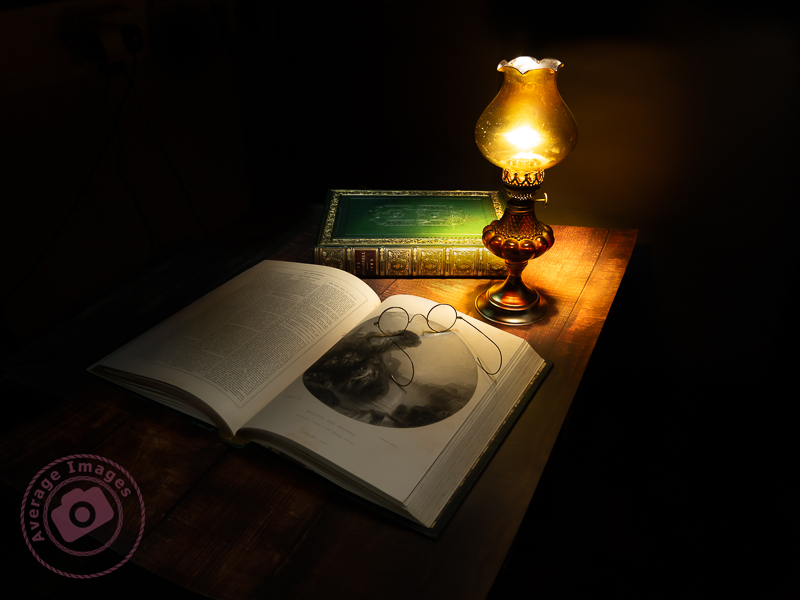
The subject of the image featured in this blog post is actually a recreation of a recreation. If you check back on my blog post The Art Journal from March 2022, you will see that I describe how I replicated a previous shot of an oil lamp and some antique Art Journal compendiums because the original image had been lost. On both previous occasions, I had used a single light source from the lit oil lamp itself, which, although atmospheric, had created some deep shadows. In this second recreation, I decided to use Painting with light to illuminate the scene (and didn’t actually light the oil lamp at all). It is a composite image, with blending modes and layer masks combining just 4 individual shots (although I took 19 shots during the actual photoshoot just to be sure that I had illuminated every part of the scene). I have to say that I am pretty pleased with the result – the lighting is far more controlled than just using the oil lamp as a light source, and to try and achieve this effect using studio strobes would have been very time-consuming and complex.
Remember, you can keep up-to-date with all of the Painting with light blog posts by subscribing:
Discover more from Ironbridge Images
Subscribe to get the latest posts sent to your email.

 Ironbridge Images